
When your server rack hits 90°F and central AC won’t cut it, a spot cooler becomes your emergency lifeline. Unlike whole-building systems, this portable unit transforms sweltering air into focused cooling relief right where you need it—whether for overheating equipment, a stifling warehouse workstation, or a home office without ducts. But how does this mobile powerhouse actually work? Spot coolers don’t magically “create cold”; they strategically move heat using physics perfected over decades. You’ll discover exactly how their internal components convert scorching air into dry, cool blasts while avoiding common pitfalls that sabotage performance.
Spot coolers deliver targeted relief by exploiting a fundamental principle: heat always flows from hot areas to cold ones. Your unit manipulates this flow using refrigerant—a specialized fluid that vaporizes at low temperatures—to absorb indoor heat and dump it outside. This process simultaneously dehumidifies the air, making spaces feel up to 15°F cooler than actual temperature. By the end of this guide, you’ll understand why spot coolers outperform fans in high-humidity environments and how to prevent the #1 mistake that turns your cooler into a space heater.
Spot Cooler Parts That Make Targeted Cooling Possible
:max_bytes(150000):strip_icc()/parts-of-a-swamp-cooler-2718628-a477e6f0787b4f8bb62ddf2def31d495.png)
Every spot cooler contains six critical components working in concert. Forget vague “parts explained” sections—here’s exactly what each piece does in real-world operation:
- Compressor: The muscle that pumps refrigerant under high pressure. When it squeezes gas, temperatures soar to 150°F+—enabling heat transfer.
- Condenser coil: The hot-side heat exchanger. You’ll feel intense heat blowing from this coil as refrigerant releases absorbed warmth.
- Expansion valve: A precision metering device. It creates a sudden pressure drop that chills liquid refrigerant to near-freezing levels.
- Evaporator coil: Where cooling magic happens. Warm room air passing over this frosty coil loses heat and moisture instantly.
- Dual-direction fans: One pulls hot air across the evaporator; another expels heat via the condenser. Weak fans = weak cooling.
- Exhaust hoses: Critical for heat removal. Single-hose models vent hot air but accidentally suck in replacement air (more on this trap later).
Pro Tip: Never block the condenser coil’s airflow. Dust buildup here reduces cooling capacity by 25% within weeks—especially critical for server room units running 24/7.
Why Single-Hose Spot Coolers Sabotage Their Own Efficiency
Single-hose units exhaust hot air through one tube but create a hidden problem: negative room pressure. As the unit pulls air to cool the condenser, it vents that heated air outside. This leaves your space with less air volume, causing two issues:
1. Warm outdoor air seeps in through doors/windows, making the unit work harder
2. Humidity rises as moist replacement air enters, counteracting dehumidification
Look for this sign: If your spot cooler runs constantly but the space feels muggy, negative pressure is likely the culprit. Dual-hose models fix this by drawing outdoor air specifically for condenser cooling—keeping your target area sealed.
How Heat Transfer Creates Instant Cooling Relief
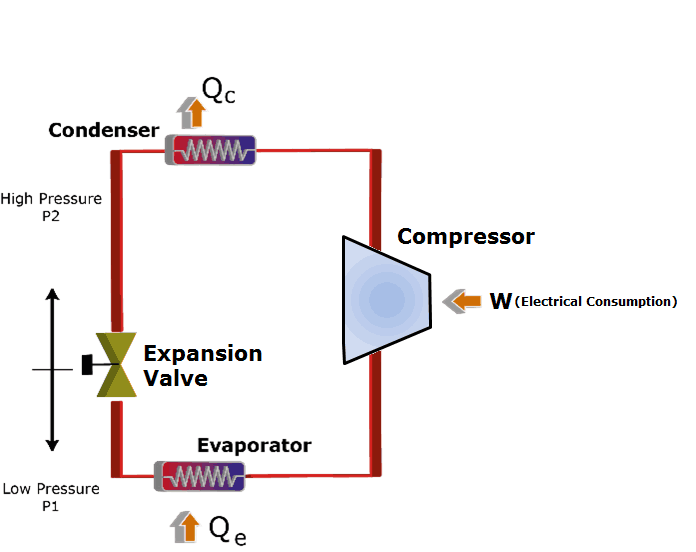
Spot coolers rely on the vapor-compression refrigeration cycle—the same science in your fridge. But unlike stationary ACs, they’re engineered for mobility and rapid deployment. Here’s the step-by-step physics in action:
Why Your Spot Cooler Transfers Heat, Not Creates Cold
Compression phase: The compressor pressurizes refrigerant gas, spiking its temperature. What you’ll see: Hot air blasting from the exhaust hose within 60 seconds of startup. This isn’t wasted energy—it’s proof heat removal is working.
Condensation phase: High-pressure gas hits the condenser coil. Outdoor air (or room air in single-hose models) absorbs this heat, turning refrigerant into liquid. Critical detail: If ambient temps exceed 110°F, condensation fails—units overheat and shut down. Always shade exhaust hoses in direct sun.
Expansion phase: Liquid refrigerant rockets through the expansion valve. Pressure plummets, dropping temps to 20-30°F. Warning: Ice forming on supply hoses means refrigerant isn’t expanding properly—likely due to low charge or clogged filter.
Evaporation phase: Super-cold refrigerant enters the evaporator coil. Room air blown across it loses heat rapidly as moisture condenses out. You’ll notice: The air exiting your unit feels drier and significantly cooler within 5 minutes. This phase absorbs 70% of the cooling workload.
Spot Cooler vs. Swamp Cooler: Don’t Mistake Evaporation for Real Cooling
Many confuse spot coolers with evaporative “swamp” coolers—but their physics differ radically:
– Spot coolers remove heat via refrigerant cycle (works in 100% humidity)
– Swamp coolers add moisture to cool air (fails above 50% humidity)
Real-world test: In a 90°F/70% humidity server room, a spot cooler drops temps to 75°F while dehumidifying. A swamp cooler would push temps higher by adding moisture—potentially triggering equipment shutdowns.
Choosing the Right Spot Cooler for Your Heat Crisis
Picking the wrong unit wastes energy and leaves you sweating. Base your decision on these battle-tested factors:
Spot Cooler BTU Calculator: Avoid the Undersizing Trap
BTU capacity must match your space’s heat load—not just square footage. A 5,000 BTU unit cools:
– 150 sq ft office with standard heat
– BUT only 100 sq ft server room (due to equipment heat output)
Critical mistake: Buyers often size by room size alone. In server rooms, multiply square footage by 30 BTU/sq ft (not 20). That 200 sq ft data closet needs 6,000 BTU—not the 4,000 BTU recommended for living spaces.
Dual-Hose vs. Single-Hose: The Efficiency Showdown

| Feature | Dual-Hose Spot Cooler | Single-Hose Spot Cooler |
|---|---|---|
| Cooling Speed | 30% faster | Slower (works against itself) |
| Humidity Control | Excellent | Poor (adds moisture) |
| Best For | Server rooms, sealed spaces | Garages, workshops |
Pro Tip: For server rooms, dual-hose is non-negotiable. The negative pressure from single-hose units pulls humid air into racks, risking condensation on hot components.
Spot Cooler Drainage Solutions That Prevent Floods
Condensation is inevitable—here’s how top units handle it:
– Self-evaporative systems: Reuse moisture to cool the condenser (ideal for <80% humidity)
– Continuous drain kits: Essential for server rooms—prevents 2+ gallons of daily water buildup
– Never rely on internal tanks in critical environments. A full tank triggers automatic shutdowns during peak heat.
Spot Cooler Maintenance That Prevents Costly Downtime
Even top-tier units fail without proper care. These steps keep your spot cooler running at peak efficiency:
Monthly Evaporator Coil Cleaning Protocol
- Power off and unplug the unit
- Remove front grille to access the coil
- Spray with no-rinse evaporator coil cleaner (never use water alone)
- Wait 10 minutes for grime to dissolve
- Wipe residue with microfiber cloth—never scrub
Why this matters: A 1/8″ layer of dust reduces cooling output by 21%. Server room units need cleaning every 2 weeks—not monthly.
Spot Cooler Hose Setup Mistakes That Waste 40% of Cooling
Most users install exhaust hoses wrong:
– Too long: Keep hoses under 5 feet—every extra foot reduces efficiency 5%
– Kinked: Sharp bends restrict airflow, causing compressor strain
– Poor sealing: Tape gaps around window kits with foil tape (not duct tape—it fails in heat)
Real consequence: A kinked 8-foot hose in a server room can push exhaust temps from 120°F to 140°F—tripping thermal shutdowns during heat waves.
When Spot Coolers Become Your Last Line of Defense
Spot coolers transform physics into practical relief for targeted heat emergencies. They work by forcing refrigerant through a closed-loop cycle that absorbs indoor heat and dumps it outside, delivering dry, cool air precisely where central systems can’t reach. Unlike fans that merely circulate hot air, they actively remove heat energy—making them indispensable for server rooms, manufacturing lines, and spot-cooling critical workspaces.
For maximum reliability: choose dual-hose models for sealed environments, size BTUs for actual heat load (not room size), and maintain coils monthly. A properly deployed spot cooler can prevent $10,000+ in equipment damage during summer peaks. When your next heatwave hits, remember—they don’t create cold. They move the heat that’s making your space unbearable. And that’s the difference between surviving and thriving when temperatures soar.