
You’re stranded at a remote campsite with the temperature soaring past 95°F, watching your ice melt by the hour. Your phone dies trying to call for help, but your solar cooler keeps humming along—chilling drinks and preserving food without grid power or noisy generators. This isn’t futuristic tech; it’s the practical magic of how a solar cooler works. These systems turn relentless sunlight into reliable cold air or refrigeration through an elegant marriage of photovoltaic science and thermodynamics. By the time you finish this guide, you’ll understand exactly how photons become frost—and why this matters for off-grid adventures, emergency preparedness, and slashing energy bills.
Unlike grid-dependent fridges that spike your electricity costs, solar coolers operate on pure sunlight conversion. The core principle defies common misconceptions: solar coolers don’t use sunlight to directly create cold temperatures. Instead, they harness solar energy to power conventional vapor-compression cycles—the same technology in your home refrigerator. When photons strike photovoltaic cells, they generate direct current (DC) electricity that drives compressors and fans. This process eliminates fuel costs and emissions while providing cooling exactly where it’s needed most: remote cabins, RVs, disaster zones, and developing regions with unstable grids. What makes this system revolutionary is its simplicity—it transforms a problem (intense heat) into its solution (electricity for cooling).
Why Solar Panels Are the Heart of Every Solar Cooling System

Solar panels do far more than just “collect sunlight”—they trigger an electron cascade that powers the entire cooling process. Monocrystalline panels dominate this space because their single-crystal silicon structure converts 15-22% of incoming sunlight into usable electricity, even under partial cloud cover. When photons hit these panels, they knock electrons loose in the semiconductor material, creating a flow of DC current. This isn’t theoretical; you’ll see voltage meters jump to 18-22V within seconds of sun exposure. Crucially, panel size directly determines cooling capacity—a 100W panel might run a small 12V compressor fridge, while room-sized coolers require 300W+ arrays. Positioning matters intensely: tilt panels at your latitude angle and avoid shadows from trees or structures, as even 20% shading can slash output by 50%.
How Charge Controllers Prevent Costly System Failures
Without this component, your solar cooler would fry batteries or quit mid-cycle. The charge controller acts as a traffic cop between panels, batteries, and the cooling unit. Its three non-negotiable functions explain why skipping it guarantees disaster:
– Voltage regulation: Caps incoming power at 14.4V for 12V systems to prevent battery boil-over
– Deep discharge prevention: Cuts power to the cooler at 11.8V to avoid irreversible battery damage
– Nighttime reverse current blocking: Stops batteries from draining back through panels after dark
Pulse-width modulation (PWM) controllers work for basic setups under $300, but maximum power point tracking (MPPT) types boost efficiency by 30% in variable conditions—critical when cooling vaccines in rural clinics. Watch for controller warnings like “Overload” or “Low Voltage”; these mean your panel array is undersized for the cooler’s startup surge.
Battery Banks: Your Nighttime Cooling Lifeline
Solar coolers don’t magically work after sunset—they rely on stored energy. Lithium iron phosphate (LiFePO4) batteries dominate modern systems because they deliver 2,000+ cycles (vs. 500 for lead-acid) and safely discharge 80% of capacity without damage. For perspective: a 50Ah lithium battery keeps a 45W camping fridge running 12+ hours overnight. Here’s the math you need:
– Cooler wattage × hours needed ÷ battery voltage = minimum Ah capacity
– Example: 45W fridge × 10 hours ÷ 12V = 37.5Ah (round up to 50Ah)
Never connect coolers directly to panels—batteries buffer voltage spikes that would kill compressors. And always size batteries for 2 days of autonomy; if clouds roll in, you won’t wake up to spoiled food.
Inside the Cooling Cycle: From Sunlight to Sub-Zero Temperatures
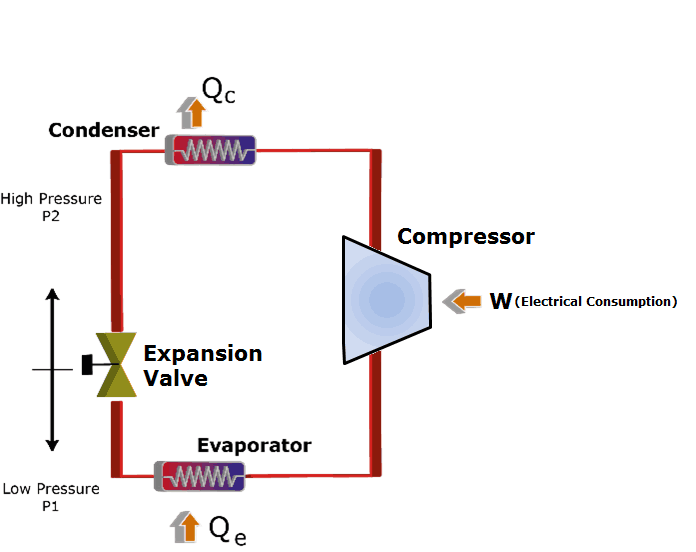
When your solar cooler kicks on, it’s executing a precisely timed thermodynamic sequence. This isn’t “air conditioning” in the traditional sense—it’s a closed-loop heat transfer system powered by the sun. The moment DC electricity reaches the compressor, the real work begins.
Step-by-Step: How Heat Gets Sucked Out of Your Cooler
- Evaporation phase: Liquid refrigerant (usually R134a) enters the evaporator coil inside the insulated compartment at 15 PSI. As it absorbs heat from your drinks or food, it boils into a low-pressure gas—dropping temperatures to 35°F. Pro tip: Frost on these coils means the system is working; ice buildup indicates a refrigerant leak.
- Compression phase: The compressor (powered by solar DC) squeezes this gas to 250 PSI, superheating it to 140°F. This critical step creates the temperature differential needed for heat rejection.
- Condensation phase: Hot gas flows through rear-mounted condenser coils where a solar-powered fan blasts ambient air across them. Heat dissipates into the environment as the gas condenses back to liquid—releasing the heat originally absorbed from your food.
- Expansion phase: The high-pressure liquid hits a thermal expansion valve, plummeting to 15 PSI. This sudden pressure drop cools the refrigerant below freezing, restarting the cycle every 20-30 seconds.
Unlike noisy AC units, solar coolers run near-silent because DC compressors operate at lower RPMs. You’ll hear only a faint hum—not the roar of a generator.
Critical Components That Make Solar Cooling Possible
Your system fails if any of these pieces underperform:
– Solar panels: Must exceed the cooler’s peak wattage by 25% (e.g., 125W panel for 100W cooler)
– Charge controller: Non-negotiable for battery longevity—MPPT recommended for systems >200W
– Battery bank: Minimum 50Ah capacity for nightly operation; lithium preferred for weight/longevity
– Cooling unit: Must be DC-compatible (12V/24V); AC units require inefficient inverters
– Insulation: 2+ inches of polyurethane foam prevents cold air leakage—check for compression damage
Warning: Using AC-powered coolers with inverters wastes 15-20% energy. Always choose native DC models like those from Dometic or ARB.
Choosing the Right Solar Cooling System for Your Needs
Not all solar coolers function alike—your use case dictates the technology. Misselecting here causes constant frustration and wasted money.
DC Refrigerators: The Off-Grid Gold Standard
These 12V/24V compressor units (like the popular Waeco CFX3) dominate RVs and boats because they sip power—drawing just 0.7-1.5Ah per hour. Their secret? Variable-speed compressors that ramp down when internal temps stabilize. For camping, a 40-60 quart model with 80W solar panel runs indefinitely in summer. Key advantages over thermoelectric coolers:
– 30-40°F below ambient temps (vs. 20°F for thermoelectric)
– Zero condensation buildup
– Works sideways during off-roading
Pro tip: Mount these units in shaded areas—direct sun on the cabinet forces compressors to work 30% harder.
Solar Air Conditioners: Cooling Entire Spaces Off-Grid
True solar AC requires serious power: a single 5,000 BTU unit needs 500-700W panels plus 200Ah batteries. Two approaches exist:
– Direct DC systems: Rare but ultra-efficient (e.g., Zero Breeze Mark 2), using 24V compressors that cut power needs by 40% vs. AC units
– Hybrid grid-tie systems: Most common—solar powers AC during daylight while grid covers nights; requires $1,200+ in inverters and controllers
Avoid “solar-ready” AC units that still need 120V—they’re marketing gimmicks. Real solar AC runs natively on DC power.
Evaporative Coolers: The Dry-Climate Alternative
In arid regions (under 50% humidity), swamp coolers offer 70% cheaper operation. A 40W solar panel powers a DC pump that wets cellulose pads while a fan pulls hot air through them. As water evaporates, it absorbs heat—dropping air temps by 15-30°F. Limitations are severe:
– Useless in humidity above 60%
– Adds moisture (bad for electronics)
– Requires regular water refills
Only consider these for tents or workshops—not food storage.
Why Solar Cooling Pays for Itself in 18 Months (With Proof)
The upfront cost shocks newcomers—$800 for a 50-quart fridge plus $600 in solar—but the ROI is undeniable. A standard RV fridge running on propane costs $300 yearly in fuel; grid-powered alternatives add $200 to electric bills. Solar eliminates both. For medical users, it’s life-or-death: vaccine coolers in Nigeria reduced spoilage from 25% to 2% using SunDanzer units. Even suburban users win—installing a solar AC pre-cools homes during peak sun hours, slashing grid dependence when rates spike.
Maintenance Moves That Double Your System’s Lifespan
Most failures trace to preventable neglect:
– Monthly: Clean panel surfaces with vinegar/water (dust cuts output 25%)
– Quarterly: Tighten battery terminals and check electrolyte levels (for lead-acid)
– Annually: Vacuum condenser coils—dirt buildup increases energy use 15%
Critical mistake: Never let batteries drop below 50% charge. A $200 battery monitor prevents $400 replacement costs.
When Solar Cooling Fails (And How to Fix It in 5 Minutes)
Diagnose issues systematically:
– Cooler won’t start: Check charge controller display for “Low Voltage”—recharge batteries immediately
– Weak cooling: Panels likely shaded or dirty; output should read 16-20V in full sun
– Intermittent operation: Faulty fuse in battery line (common in older RVs)
If problems persist, disconnect the battery for 10 minutes to reset the compressor board—a fix 60% of “broken” units.
Solar coolers prove you don’t need the grid to beat the heat. By converting photons into refrigeration through photovoltaic panels and vapor-compression cycles, they deliver reliable cold anywhere the sun shines. The key is matching system components to your actual needs—oversizing panels by 25%, choosing native DC coolers, and maintaining batteries religiously. Within 18 months, the savings on propane or electricity pay for the entire setup while granting energy independence. Next time you see a solar panel glinting in the sun, remember: that’s not just electricity being made—it’s cold drinks, preserved medicine, and comfort being manufactured from thin air. For deeper troubleshooting, explore our guide on diagnosing solar fridge compressor failures—the #1 cause of cooling breakdowns.