You’re sweating through another scorching afternoon in Phoenix when your swamp cooler kicks on, instantly replacing hot, dusty air with a refreshing breeze. But how does an evaporative cooler work without the complex machinery of a traditional AC? Unlike refrigerant-based systems, it harnesses a 5,000-year-old natural principle: when water evaporates, it pulls heat from the air. This simple physics trick makes evaporative coolers 75% more energy-efficient than standard AC—but only where humidity stays low.
If you live in Arizona, Nevada, or New Mexico, understanding this process could slash your summer electricity bills by hundreds of dollars. We’ll break down exactly how hot desert air transforms into cool comfort inside your unit, why humidity makes or breaks its performance, and whether it’s right for your climate. You’ll learn the step-by-step physics, avoid common installation mistakes, and discover why these “swamp coolers” are actually eco-friendly marvels—not relics.
Water Reservoir, Pump, and Pads: Your Cooler’s Core Components
Every evaporative cooler relies on five critical parts working in unison. Forget complicated compressors; this system thrives on simplicity. The water reservoir stores your supply, while a small pump circulates it upward. At the top, a distribution system (like a drip hose or perforated pipe) saturates the cooling pads—thick cellulose or aspen wood layers designed to maximize water exposure.
Why Cooling Pad Material Determines Efficiency
Aspen wood pads absorb water like a sponge but clog faster in hard water areas. Synthetic cellulose pads resist mineral buildup but cost more upfront. Both create massive surface area for evaporation—critical because more water exposure = faster cooling. If pads dry out even partially, cooling plummets. Check pads weekly during peak season; they should feel uniformly damp, never crusty.
Fan Power Requirements for Effective Airflow
Your unit needs a fan strong enough to pull air through saturated pads, not just over them. Undersized fans cause “channeling,” where air bypasses wet surfaces. For whole-house systems, calculate 20-40 air changes per hour. A 2,000 sq ft home typically requires 4,000+ CFM fan capacity. Listen for weak airflow—that’s your first sign of pad saturation issues.
Step-by-Step: How Hot Air Becomes Cool in 90 Seconds
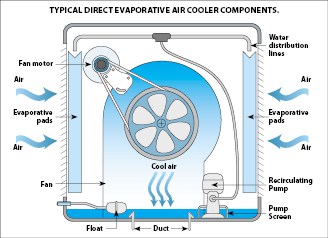
The magic happens in a continuous cycle that transforms 100°F desert air into 75°F comfort. No refrigerants, no ozone harm—just water and physics. Here’s exactly how hot air enters your unit and exits cool:
Air Intake Through Saturated Cooling Pads
Your cooler’s fan pulls dry outside air through waterlogged pads. As air molecules collide with wet surfaces, they absorb water vapor. This isn’t passive soaking—it’s forced evaporation driven by airflow pressure. Critical detail: Air must move slowly through pads (500-700 ft/min) to maximize contact time. Rush it, and cooling efficiency drops 30%.
Heat Transfer During Evaporation Explained Simply
When water evaporates, it steals heat from the air via “latent heat of vaporization.” Each gram of water needs 585 calories to vaporize—energy pulled directly from passing air. This isn’t cooling the water; it’s cooling the air itself. In dry climates, this drops temperatures 15-30°F instantly. Watch for mist escaping vents—that means excess humidity; reduce water flow.
Delivering Fresh, Cool Air to Your Space
Unlike AC that recirculates stale indoor air, your swamp cooler blows 100% fresh outdoor air—filtered by the pads. But here’s the catch: you must open windows 1-2 inches. This creates positive pressure, pushing cooled air in while exhausting humid air. Seal your home like AC, and humidity builds until cooling stops entirely. Pro tip: Open windows downwind from the cooler for optimal airflow.
Why Humidity Below 60% Is Non-Negotiable for Cooling

Your evaporative cooler’s performance lives or dies by one number: relative humidity. This isn’t a preference—it’s physics. Dry air acts like a thirsty sponge, absorbing vapor rapidly. Humid air? Already soaked.
Low Humidity: How Desert Air Achieves 30°F Drops
In Tucson (average RH: 35%), 100°F air entering your cooler can exit at 72°F. Why? The air’s “wet-bulb temperature” (the lowest possible cooling point) sits 28°F below dry-bulb readings. Check your local weather app for wet-bulb temps—if it’s above 70°F, your cooler won’t reach comfort levels.
High Humidity: Why Swamp Coolers Fail in Muggy Climates
In Houston (RH often >70%), the same 100°F air only cools to 85°F—barely refreshing. Worse, the unit adds more humidity, making air feel stickier. Red flag: If cooled air feels clammy within 10 minutes, your climate is too humid. Don’t waste money; switch to AC. Coastal or southeastern U.S. residents: evaporative coolers rarely work here.
Swamp Cooler vs AC: Why They’re Opposites in Every Way
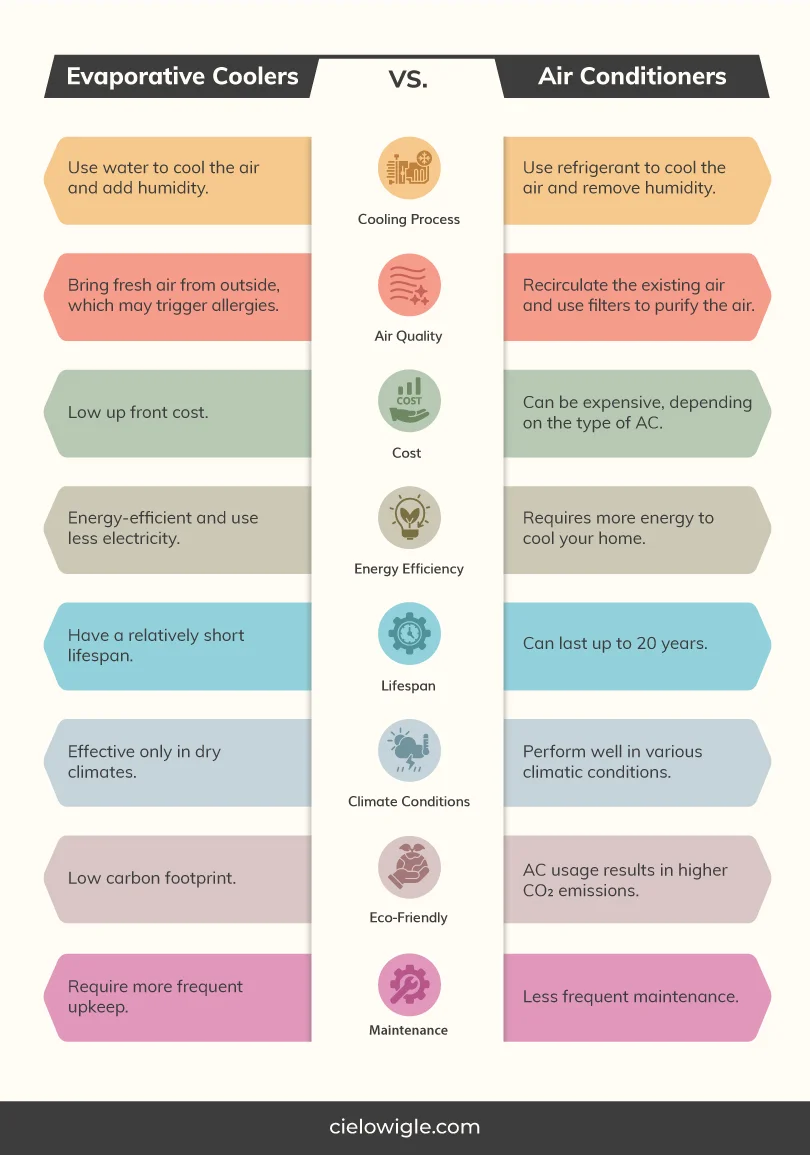
These systems solve the same problem through completely different physics. Choosing wrong means wasted money and discomfort. Use this comparison before buying:
| Feature | Evaporative Cooler | Traditional AC |
|---|---|---|
| Cooling Method | Steals heat via water evaporation | Moves heat outdoors via refrigerant |
| Humidity Effect | Adds moisture (ideal for dry climates) | Removes moisture (ideal for humidity) |
| Energy Use | 1-2 amps (like a fan) | 15-20 amps (compressor load) |
| Ventilation | Requires open windows | Requires sealed rooms |
| Best For | Dry climates (SW USA, Australia) | Humid climates (SE USA, tropics) |
| Cost to Run | $0.05-$0.15/hour | $0.50-$1.50/hour |
The Fresh Air Advantage You Can’t Ignore
While AC recirculates indoor air (spreading dust and odors), swamp coolers constantly pull in filtered outside air. This slashes indoor pollutants by 80%—a lifesaver for allergy sufferers in dusty regions. But remember: if wildfire smoke blankets your area, close windows and switch to AC’s recirculation mode.
5 Unexpected Benefits of Evaporative Cooling in Dry Climates
Slash Energy Bills by 75% Overnight
Running costs plummet because only the fan and small pump draw power. A whole-house unit uses less electricity than two incandescent bulbs. In Arizona, this means $15-$30/month cooling bills versus $150+ for AC.
Combat Desert Dryness While Cooling
Low humidity in places like Denver causes cracked skin and nosebleeds. Swamp coolers add just enough moisture (40-50% RH) for comfort—no separate humidifier needed. Plants and wooden furniture stay healthier too.
Zero Harmful Refrigerants
No HFCs leaking into the atmosphere. Just water vapor returning to the natural cycle. For eco-conscious homeowners, this eliminates 1-2 tons of CO2 equivalent emissions yearly.
Instant Installation Without Professional Help
Window-mounted units install in 30 minutes—no ductwork, refrigerant lines, or permits. Renters love this. Whole-house systems connect to existing ducts but skip AC’s complex compressors.
Self-Filtering for Cleaner Air
Dust and pollen get trapped in wet pads before air enters your home. Replace pads monthly during peak season, and you’ve got built-in air purification.
Critical Limitations: When NOT to Use an Evaporative Cooler
Humidity Above 60% Renders Cooling Useless
Check real-time humidity via Weather.gov. If RH exceeds 60% for more than 2 hours daily, skip evaporative cooling. In Albuquerque, it works 300 days/year; in Atlanta, maybe 30.
Hard Water Destroys Pads in Weeks
Calcium and magnesium in water crystallize on pads, blocking airflow. If your area has hard water:
– Install a reverse osmosis filter ($200)
– Use “anti-scale” water treatment tablets
– Rinse pads weekly with vinegar solution
Wet-Bulb Temperature Sets Your Cooling Limit
You can’t cool air below the outdoor wet-bulb temperature. In Phoenix summer, this might be 72°F—perfect. But during monsoon season, it jumps to 80°F, making cooling impossible. Always check wet-bulb temps before installation.
Direct vs Two-Stage Coolers: Which Suits Your Climate?
Standard Direct Coolers for Extreme Dryness
Best for deserts under 40% RH. Air passes directly through wet pads. Simple, affordable, but adds max humidity. Ideal for garages, workshops, or homes where open windows aren’t an issue.
Two-Stage Coolers for Moderately Humid Areas
First, pre-cool air indirectly via a heat exchanger. Then push it through pads. This achieves 5-10°F lower temps than direct coolers and adds less humidity. Worth the 20% price premium if your RH hits 50-60% seasonally—like in parts of California.
Prevent Mold and Scale: 4 Non-Negotiable Maintenance Steps
- Drain and scrub the reservoir weekly with 1 cup vinegar to stop algae. Stagnant water breeds bacteria within 48 hours.
- Replace pads annually—or biannually in hard water zones. Crumbly, white-crusted pads cut cooling by 50%.
- Clean the pump strainer monthly. Debris clogs cause dry spots on pads.
- Winterize completely: Drain all water, remove pads, and store them dry. Frozen water cracks reservoirs.
Ignoring maintenance turns your cooler into a mold factory. If you smell mustiness, power wash pads immediately and replace the water.
Final Note: How does an evaporative cooler work? It transforms hot, dry air into comfort by harnessing evaporation’s natural heat theft—no compressors, no chemicals. For dry-climate homeowners, it’s the ultimate energy-saving hack, cutting costs while flooding your home with fresh air. But if humidity regularly exceeds 60%, you’ll waste money and comfort. Test it on a dry summer day: open windows, feel that desert-cool breeze, and watch your electricity meter barely move. For most Southwest residents, this ancient technology remains the smartest cooling choice on Earth.