
You packed your YETI cooler with dry ice for that critical weekend camping trip, only to discover soggy sandwiches and lukewarm drinks by day two. That sinking feeling—wasted food, ruined plans, and the nagging question: why didn’t the dry ice last? With YETI’s legendary insulation, you expected days of sub-zero reliability. The harsh truth? Without precise preparation, your dry ice might vanish in under 36 hours. But when executed correctly—using the exact methods outlined here—a 10-pound block can lock temperatures at -109°F for 3 to 5 full days. This guide reveals the science-backed packing sequence, critical safety steps, and real-world timelines you need to transform your YETI into a deep-freeze fortress. No guesswork. Just guaranteed frozen results.
Why Your Dry Ice Vanishes in Hours (Without These Steps)
Dry ice sublimates—turning directly from solid to gas at -109.3°F—and this process accelerates dramatically when key factors are ignored. Most users make one fatal error: treating dry ice like regular ice. Unlike water ice, dry ice doesn’t melt; it evaporates into CO₂ gas. Every second warm air touches it, you lose cooling power. Your YETI’s rotomolded walls and freezer-grade gasket are your best defense, but they’re powerless against these three pitfalls.
The Top 3 Dry Ice Killers in YETI Coolers
1. Skipping the 24-Hour Pre-Chill
Putting room-temperature drinks or warm food into your cooler forces dry ice to burn through its limited cooling capacity just to freeze those items. Without pre-chilling the cooler itself and all contents, you waste 50% of your dry ice before the trip even starts. Result: 10 lbs of dry ice may last only 18–36 hours instead of 5 days.
2. Air Space = Instant Sublimation
Warm, humid air trapped inside the cooler is dry ice’s worst enemy. Every cubic inch of empty space acts like a thermal battery soaking up cold. A half-packed Tundra 45 with 10 lbs of dry ice loses cooling power 3x faster than a fully packed unit. Remember: “Empty air kills dry ice.”
3. Frequent Lid Openings
Each time you lift the lid, dense CO₂ gas escapes and warm air floods in. Three quick openings per day can slash dry ice longevity by 40%. In direct sunlight? That number jumps to 70%.
How Ambient Conditions Accelerate Dry Ice Loss
| Condition | Impact on 10 lbs Dry Ice in Tundra 45 | Max Lifespan |
|---|---|---|
| Direct sun, 90°F+ | Sublimates 2.5x faster | 1–2 days |
| Shaded area, 75°F | Standard sublimation rate | 3–5 days |
| Pre-chilled, packed, shaded | Minimal heat transfer | 4–6+ days |
Step-by-Step: Pack Your YETI for 5+ Days of Dry Ice Performance

This sequence—tested in extreme conditions from Alaskan expeditions to medical supply transport—turns theoretical longevity into reality. Do not skip the 24-hour pre-chill. It’s the non-negotiable foundation.
Pre-Chill Protocol: The 24-Hour Rule
- Freeze the Empty Cooler: Place your YETI Tundra or Roadie (lid closed) in a deep freezer for 24 hours. Rotomolded walls absorb cold, creating a thermal buffer.
- Pre-Freeze Every Single Item: Drinks, food, even empty water bottles. Anything going inside must be solid ice. Pro Tip: Fill bottles 90% full—water expands when frozen.
- Acquire Dry Ice Last: Buy dry ice the morning of departure. Never store it in a home freezer—it sublimates faster in warmer environments.
Strategic Packing Sequence for Zero Air Space
- Line the Bottom: Remove pre-chilled cooler and items from freezer. Immediately place a 2-inch layer of pre-frozen water bottles or gel packs on the base.
- Wrap and Position Dry Ice: Cover dry ice block with 2–3 sheets of newspaper (slows sublimation slightly). Place it centered on the frozen layer—never touching cooler walls.
- Pack Like a Tetris Master: Surround dry ice with pre-frozen items. Fill every gap with frozen water bottles. Goal: When closed, the lid latches with firm pressure—no give.
- Top Layer Strategy: For Roadie 24s, place dry ice on top of contents. In larger Tundras, center placement distributes cold more evenly.
Critical Opening Technique
- Plan Retrievals: Open cooler once per meal. Grab all needed items in 15 seconds.
- Use the Lid as a Shield: In rain or sun, crack the lid just enough to reach items. Never prop it open.
- Re-Seal Immediately: YETI’s gasket creates a seal within 2 seconds of latching—don’t delay.
Real-World Dry Ice Timelines by YETI Model

These durations assume full pre-chill, zero air space, and minimal openings in shaded conditions. Halve these times if you skip pre-chilling.
Tundra 45 (45 Quarts) with 10 lbs Dry Ice
- Days 1–3: Rock-solid -109°F. Food stays frozen like a commercial freezer.
- Day 4: Dry ice reduces to 30% of original mass. Still maintains 0°F for frozen items.
- Day 5+: Only usable for refrigeration (32–40°F). Total frozen storage: 4 full days.
Roadie 24 (24 Quarts) with 5 lbs Dry Ice
- Days 1–2: Deep-freeze performance (-10°F).
- Day 3: Drops to 20°F. Ideal for drinks and short trips.
- Day 4: Approaching 40°F. Total frozen storage: 2.5 days.
Tundra 65 (65 Quarts) with 25 lbs Dry Ice
- Days 1–5: Sustains -20°F. Perfect for medical supplies or hunting trips.
- Days 6–8: Holds 0–10°F. Still freezes meat solid.
- Day 10+: Refrigeration only. Total frozen storage: 7–8 days.
Hybrid Ice Strategy: Double Your Dry Ice Longevity
Combine dry ice with regular ice for unmatched performance—this is how professionals maintain sub-zero temps for 10+ days. Here’s why it works: Dry ice placed on top of water ice freezes the entire mass into a single thermal battery. The frozen water ice then acts as insulation, slowing dry ice sublimation by 30–50%.
How to Execute the Hybrid Method
- Fill cooler ⅔ full with regular ice or frozen gel packs.
- Place dry ice block on top (wrapped in newspaper).
- Add final layer of regular ice to cover dry ice.
- Seal and monitor: The top layer stays frozen while dry ice preserves the core.
Result: In a pre-chilled Tundra 65, this method extends frozen storage to 9–12 days—ideal for remote expeditions.
Critical Safety Rules for YETI Dry Ice Use
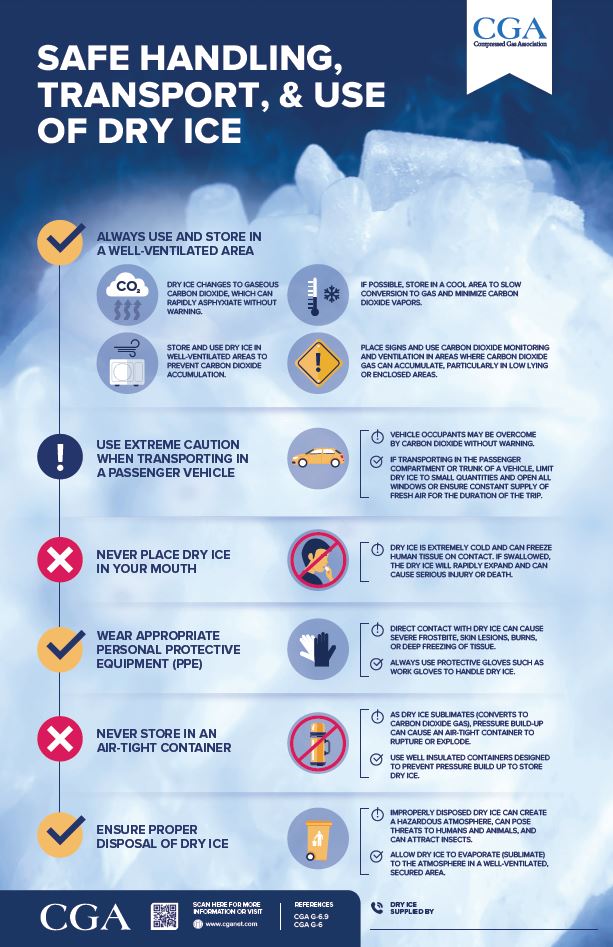
Three Non-Negotiables
- Gloves or Frostbite Guaranteed: Handle dry ice only with thick insulated gloves. Skin contact causes third-degree burns in 5 seconds.
- Ventilation is Life-or-Death: Never store a dry ice-packed YETI in a sealed car trunk, tent, or small room. CO₂ displaces oxygen silently. Pro Tip: Crack a car window 2 inches when transporting.
- Hard Coolers Only: Dry ice shatters Hopper soft coolers and Rambler lids due to extreme cold. Use only Tundra, Roadie Hard-Sided, or TANK Ice Bucket.
Why YETI Coolers Are Safe (When Used Correctly)
YETI’s gasket creates a tight seal—not airtight. Latches allow gradual CO₂ venting, preventing pressure buildup. Never modify latches or add external straps that could seal the cooler airtight. If you hear hissing when opening, back away and let it vent for 5 minutes.
When to Choose Dry Ice vs. Regular Ice
| Scenario | Dry Ice | Regular Ice |
|---|---|---|
| Keeping meat frozen >72 hours | ✅ Lasts 3–5x longer | ❌ Melts in 2–3 days |
| Transporting vaccines | ✅ -109°F kills pathogens | ❌ Risk of temperature spikes |
| Short day trips (<24 hrs) | ❌ Overkill, safety risk | ✅ Simple and safe |
| Kids’ lunchboxes | ❌ Frostbite hazard | ✅ Perfect |
Final Verdict: How Long Will Your Dry Ice Last?
A 10-pound block in a properly pre-chilled, fully packed YETI Tundra 45 delivers 4 full days of deep-freeze performance—enough to keep steaks rock-solid through a long weekend. But this isn’t luck; it’s physics executed precisely. Skip the pre-chill, and you’ll get one night. Pack with air gaps, and it’s two days. Follow this protocol to the letter, and your cooler becomes a mobile deep freezer. One final pro tip: Place a freezer thermometer inside. When it reads above 0°F on day 4, add more dry ice without opening the cooler—slide it through the drain plug hole. Now go conquer the backcountry with frozen confidence.