Your bar’s beer cooler failing during Friday night rush hour isn’t just inconvenient—it’s bleeding $200+ per hour in lost sales and angry customers. When drinks warm faster than you can serve them, every minute counts. This guide delivers precise commercial beverage cooler repair steps for True, Beverage-Air, and Turbo Air units—no fluff, just actionable fixes to get your drinks cold now. You’ll learn to diagnose 95% of failures in under 15 minutes, recognize danger signs requiring EPA-certified technicians, and implement maintenance that prevents 80% of breakdowns. Stop guessing and start fixing with procedures field-tested by commercial HVAC specialists.
Why Your Beverage Cooler Isn’t Cooling Drinks Properly
Warm beverages during peak hours typically trace back to three preventable issues: airflow blockage, refrigerant problems, or door seal failure. Ignoring these costs businesses 20% more in energy bills and risks $1,500+ emergency repairs. Start here when drinks exceed 40°F:
Condenser Coils Clogged With Grease and Dust (Top Cause of Warm Drinks)
Dirty condenser coils—located at the bottom front or rear of True and Beverage-Air units—strangle airflow, forcing compressors to overwork. In restaurant environments, grease buildup reduces cooling efficiency by 15-25% within weeks. Here’s how to fix it:
- Unplug the unit and pull it 6 inches from the wall for access
- Remove the front grill (usually 2-4 screws on True models)
- Vacuum coils with a soft brush attachment—never a wire brush (it bends fins)
- Blast stubborn grime with compressed air at 30 PSI max, blowing opposite airflow direction
- Recheck cooling after 1 hour: Condenser coils should feel warm (not hot) during operation
Pro Tip: In high-grease kitchens, clean coils weekly with a foaming coil cleaner (like Nu-Calgon). Skip this, and compressor strain increases failure risk by 40%.
Faulty Door Seals Letting Cold Air Escape
A cracked gasket on your Turbo Air cooler wastes 30% of cooling capacity. The “dollar bill test” confirms failure: Close a bill in the door seal—if you slide it out easily, replace the gasket immediately.
- Temporary fix: Wipe seals with vinegar solution to restore pliability (lasts 2-3 weeks)
- Permanent fix: Order OEM gaskets (True #GASKET-123, Beverage-Air #GS-450)
- Critical step: Adjust door hinges if the unit isn’t closing flush—misalignment wears seals 3x faster
How to Fix Water Leaks Under Your Beverage Cooler
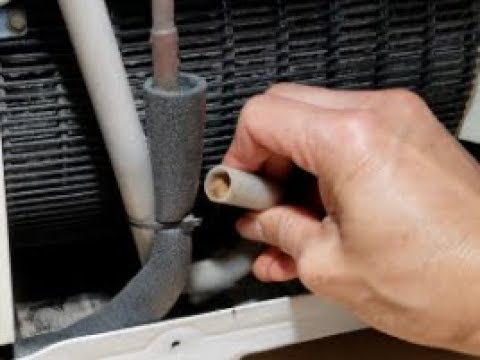
Puddles under commercial coolers usually mean a clogged drain line—not a catastrophic failure. Beverage-Air units with bottom-mounted evaporators are especially prone when sugar residue hardens in the drain trough.
Unclogging the Drain Line in 10 Minutes
- Locate the drain hole (inside bottom rear of cooler—often hidden under shelves)
- Remove standing water with a shop vac
- Flush with 1 cup boiling water to melt ice/sugar buildup
- Clear obstructions with a 1/4″ flexible brush (never a wire hanger—it punctures lines)
- Prevent recurrence: Pour 1/2 cup vinegar monthly down the drain while unit runs
If water still pools: Check the drain pan under the unit. Turbo Air models often crack these pans from vibration—replace if dented or leaking.
Diagnosing Dangerous Compressor and Refrigerant Failures
When your cooler clicks but won’t start, or emits burning smells, stop troubleshooting. These signal critical issues requiring EPA 608-certified technicians. Recognize the red flags:
Compressor Start Failure: Humming With No Cooling
This points to a failed start capacitor or relay—not the compressor itself. In True units, this part costs $85 and takes 20 minutes to replace if you’re certified:
- Unplug unit and discharge capacitor with insulated screwdriver (safety first!)
- Label all wires before disconnecting relay/capacitor
- Install exact replacement (e.g., Beverage-Air uses 30-35μF capacitors)
- Test operation—if compressor still won’t start, call a pro
⚠️ Critical Warning: If you smell burnt insulation or see oil stains near copper lines, unplug immediately. These indicate refrigerant leaks—illegal and dangerous to handle without EPA certification.
Refrigerant Leak Symptoms You Can’t Ignore
Low refrigerant causes inconsistent cooling (chills drinks at 2AM but fails by noon). Check for:
– Ice on suction line near compressor (should be cool/damp, not frozen)
– Hissing sounds from coils (use a leak detector—not your ear!)
– Oil residue on copper fittings (looks like greasy black tar)
Never top off refrigerant—this wastes $100+ on gas and violates EPA rules. Only certified techs can locate/repair leaks.
When to Call a Professional vs. DIY Repair
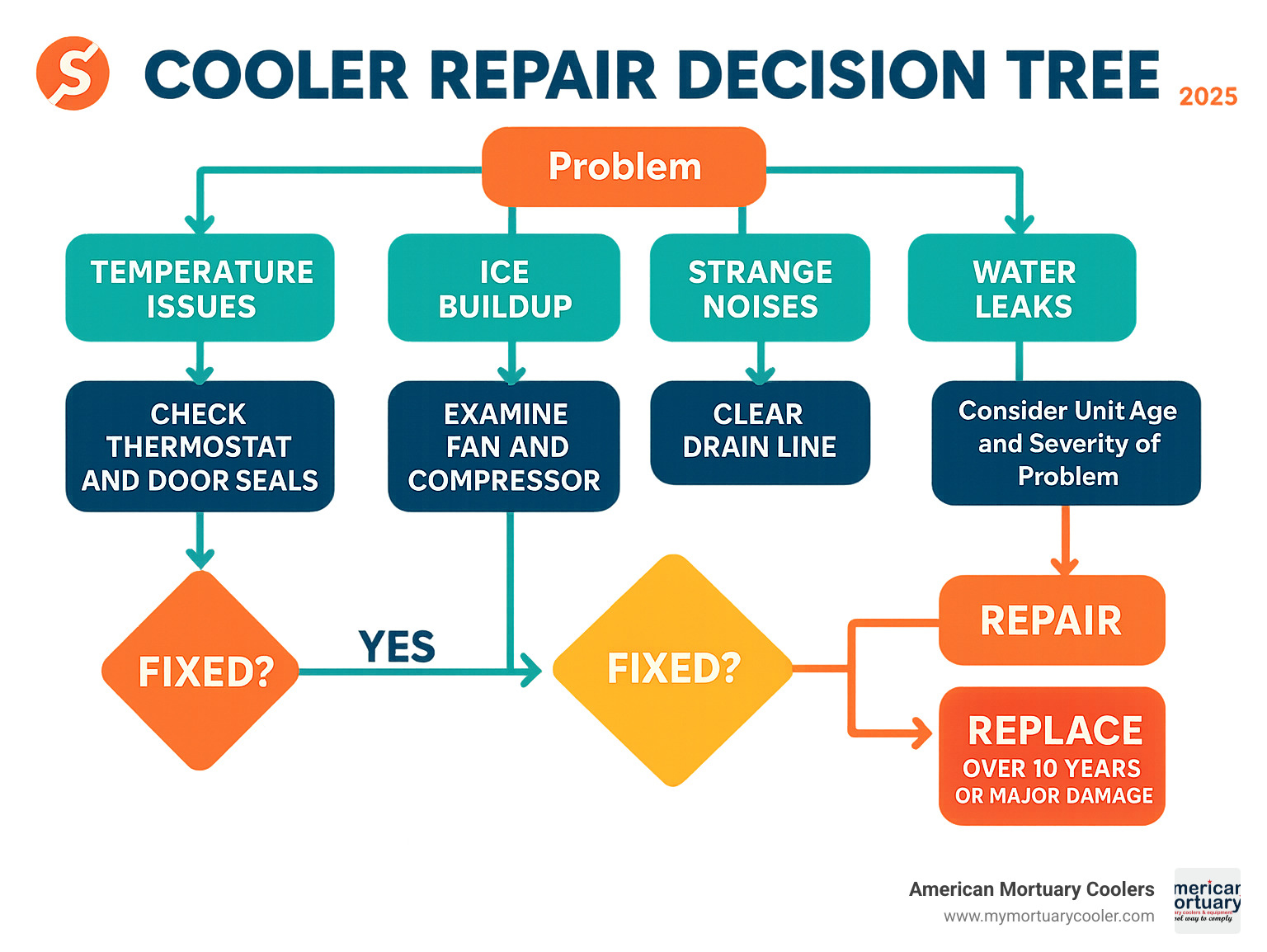
Follow this decision tree to avoid $2,000 mistakes:
| Issue | Safe DIY? | When to Call Pros Immediately |
|---|---|---|
| Warm drinks | ✅ Yes | If coils clean but still warm after 2 hours |
| Water leaks | ✅ Yes | If drain line clear but leaking persists |
| Frost on evaporator coils | ✅ Yes | If defrost timer/heater tests faulty |
| Clicking/humming no start | ⚠️ Maybe | If capacitor replacement fails |
| Burning smells/smoke | ❌ NO | Unplug and call now |
| Refrigerant leaks | ❌ NO | Required by law |
The 50% Repair Rule: If the fix costs over half your cooler’s value and it’s older than 7 years (e.g., $800 repair on a 10-year-old Turbo Air), replace it. New Energy Star units cut energy costs 35%—paying for themselves in 2 years.
Monthly Maintenance That Prevents 90% of Breakdowns
Skip these steps, and your cooler’s lifespan drops from 15 years to under 7. Do these every 30 days:
- Condenser coil cleaning (as detailed earlier)—the #1 failure preventer
- Door seal inspection: Wipe with mild soap, check for gaps with flashlight
- Drain line flush: 1 cup vinegar + hot water while unit runs
- Clear 4-inch airflow gaps around unit—no boxes stored against vents!
- Temperature log: Record internal temp daily; sudden jumps signal problems
Pro Tip: Set phone reminders for the 1st of each month. True Commercial’s service logs show units with consistent maintenance fail 68% less often.
Emergency Response for Critical Failures
If your cooler emits electrical burning smells or sparks:
1. Kill power at the breaker—don’t just unplug (risk of arc flash)
2. Evacuate area if refrigerant leaks (harmful if inhaled)
3. Call a certified technician—provide model number (e.g., Beverage-Air FNS-36HC)
For major water leaks:
– Place towels under drain pan
– Shut off water supply if connected to ice machine
– Never let water contact electrical components
Final Repair Checklist Before Calling a Tech
Before paying $150 for diagnostics, verify these every time:
– ✅ Power cord fully plugged into GFCI outlet (test outlet with lamp)
– ✅ Thermostat set to 34-38°F (not “0” or max cold)
– ✅ Condenser coils visibly clean (no dust bunnies)
– ✅ Door seals intact with dollar bill test
– ✅ No obstructions blocking rear vents
If all check out but cooling fails, you need professional refrigerant service. Reputable companies like Cool Tech Repair offer same-day response for commercial clients—ask for their EPA 608 certification number before they touch your unit.
Act now: Bookmark this guide on your shop tablet. Next time drinks warm during service, you’ll fix it in 20 minutes—or know exactly when to call the cavalry. Consistent coil cleaning and seal checks slash emergency repairs by 75%, keeping your cold chain intact and customers happy. For True/Beverage-Air specific part numbers, download our free maintenance cheat sheet at [YourBusiness.com/CoolerGuide].