
Have you ever wondered how a portable car cooler can chill your drink without any noisy compressor or refrigerant chemicals? The secret lies in a remarkable piece of technology that operates silently with no moving parts. Thermoelectric coolers use electricity alone to create cold temperatures through the fascinating physics of semiconductor materials. In this guide, you’ll discover exactly how does a thermoelectric cooler work, from the basic science to the practical applications that make these devices perfect for everything from wine refrigeration to scientific instruments. Understanding this process reveals why these coolers excel in specific situations where traditional refrigeration falls short.
Unlike conventional refrigerators that rely on compressors and chemical refrigerants cycling through evaporation and condensation, thermoelectric coolers work on entirely different principles. They’re solid-state devices that can both cool and heat depending on current direction, making them incredibly versatile. By the end of this guide, you’ll understand the precise mechanisms that allow these clever devices to move heat against its natural flow, creating cold temperatures anywhere you need them.
Why Your Thermoelectric Cooler Needs Both Hot and Cold Sides
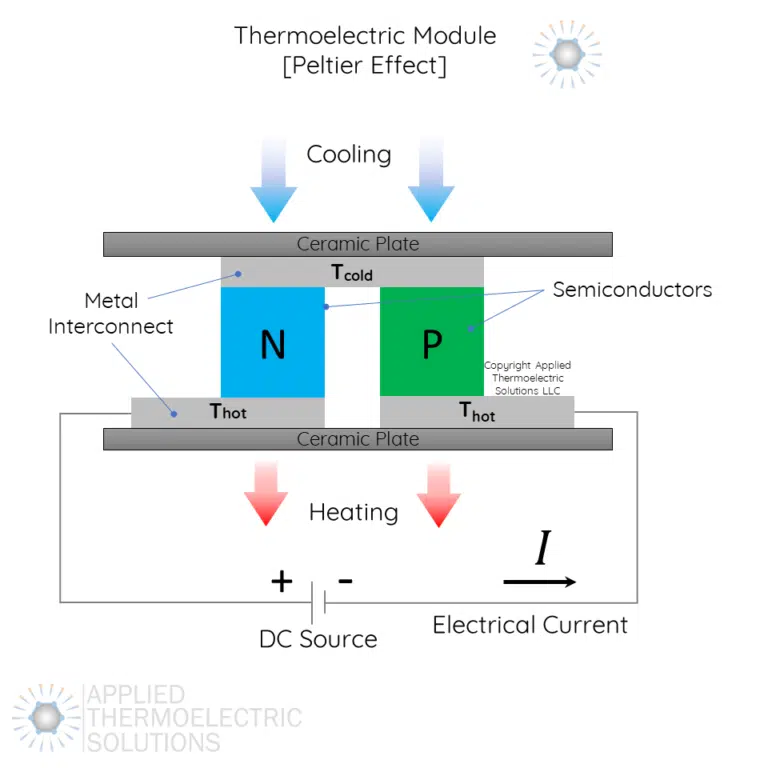
A thermoelectric cooler functions as a solid-state heat pump that moves thermal energy rather than creating “cold” from nothing. At its heart is a Peltier module containing alternating N-type and P-type semiconductor pellets sandwiched between two ceramic plates. When you apply DC current, these semiconductors create a temperature difference through the Peltier effect—the fundamental principle that explains how does a thermoelectric cooler work.
The magic happens at the junctions between these semiconductor materials. As electrons flow through the N-type material and “holes” (the absence of electrons) move through the P-type material, heat gets carried from one side of the device to the other. This coordinated movement creates a cold side that absorbs heat from your drinks or electronics while simultaneously creating a hot side that must dissipate that same heat plus the electrical energy input.
How N-Type and P-Type Semiconductors Create Cooling
The semiconductor pellets inside your thermoelectric cooler are typically made from bismuth telluride compounds, carefully engineered to maximize their thermoelectric properties. In the N-type semiconductors, electrons carry both electrical current and thermal energy from the cold side to the hot side. Meanwhile, in the P-type materials, the movement of “holes” serves the same heat-carrying function but in the opposite electrical direction.
When you connect the module to power, electrons in the N-type material absorb heat as they jump from atom to atom, effectively “picking up” thermal energy on the cold side. Simultaneously, holes in the P-type material absorb heat as they move in the opposite direction. This dual-action creates a powerful heat-pumping effect that continuously transfers thermal energy across the module. The ceramic plates sandwiching these semiconductors provide structural support while maintaining electrical insulation.
What Happens When You Plug In Your Thermoelectric Cooler
When you power up your thermoelectric cooler, the DC current creates an immediate temperature gradient across the module. The cold side begins absorbing heat from whatever you’re trying to cool—whether it’s a beverage can or a sensitive electronic component—while the hot side starts releasing that heat plus the electrical energy converted to thermal energy.
This process explains why thermoelectric coolers require both sides to function properly. The hot side typically becomes significantly warmer than ambient temperature—sometimes 30°C or more above room temperature—which is why effective heat dissipation is absolutely critical. For every watt of cooling you get on the cold side, your thermoelectric cooler must dissipate 3-4 watts of heat from the hot side. Without proper heat sinking, the hot side would quickly overheat, causing the temperature difference to collapse and your cooler to stop working effectively.
The Peltier Effect: Your Thermoelectric Cooler’s Secret Weapon
The Peltier effect is the specific physical phenomenon that enables thermoelectric cooling without any moving parts. When electricity flows through junctions of different conductors, heat gets absorbed on one side and released on the other. This isn’t just theoretical—it’s the exact mechanism that allows your portable cooler to chill drinks while you’re on the road. Understanding how does a thermoelectric cooler work means recognizing that the Peltier effect creates a directional heat flow determined by the current’s direction.
Why Your Thermoelectric Cooler’s Heat Sink Must Be Massive
The heat sink on your thermoelectric cooler isn’t just an add-on—it’s absolutely essential to the device’s operation. Since the hot side must dissipate significantly more heat than what’s being removed from the cold side, the heat sink needs to be 5-15 times larger than the cooling surface itself. Most commercial units incorporate aluminum fins with a high static-pressure fan to push air through the dense fin structure.
Without this substantial heat dissipation capability, the hot side temperature would quickly rise, reducing the temperature difference the module can maintain. If the hot side gets too warm, your thermoelectric cooler’s performance plummets—sometimes to the point of zero cooling capacity. This explains why thermoelectric coolers work best in cooler ambient temperatures and why they struggle in hot environments without exceptional heat sinking.
Thermoelectric Cooler Performance: Strengths and Limitations
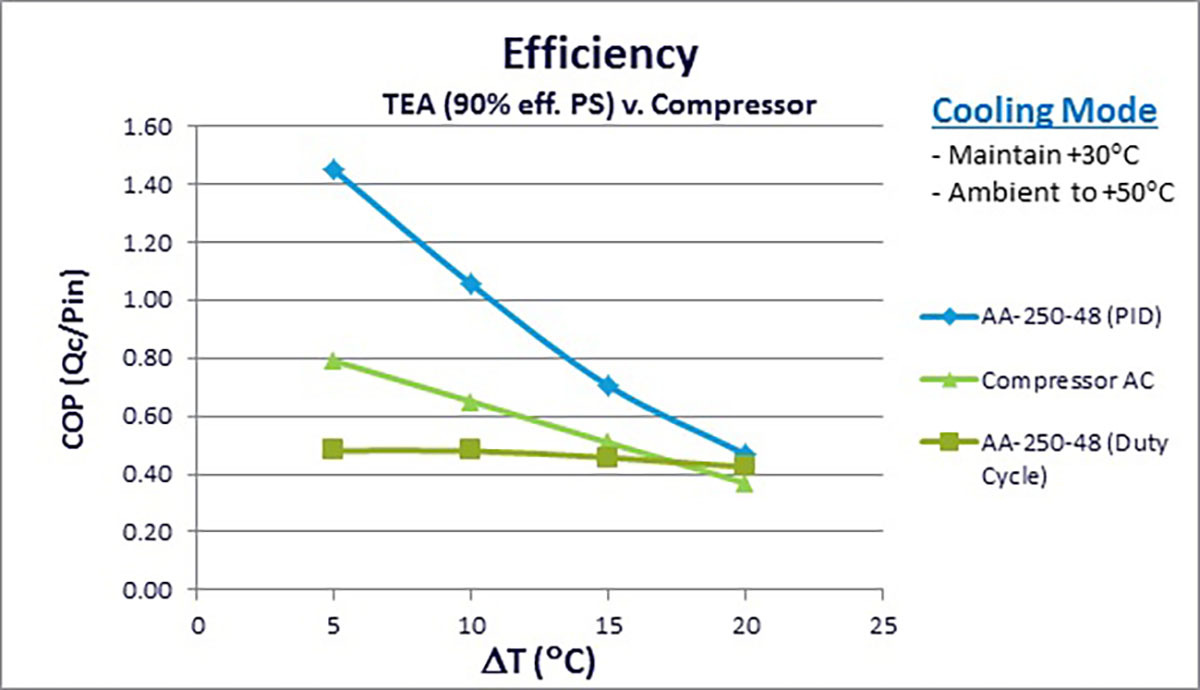
While thermoelectric coolers offer unique advantages, they also have specific limitations that determine where they excel. Understanding these performance characteristics helps you determine when a thermoelectric solution makes sense versus traditional refrigeration. Knowing how does a thermoelectric cooler work reveals why they’re perfect for some applications but impractical for others.
Where Thermoelectric Coolers Shine
Solid-state reliability: With no moving parts except the cooling fan, thermoelectric coolers offer exceptional longevity and silent operation. This makes them ideal for:
- Vibration-sensitive applications: Wine coolers where vibrations would disturb sediment
- Medical equipment: Blood analyzers and DNA amplification devices where compressor vibrations could ruin tests
- Precision instruments: CCD cameras in telescopes requiring extreme stability
Precise temperature control: By adjusting the input current, you can achieve temperature stability within ±0.1°C—far better than most compressor systems. This precision makes thermoelectric coolers perfect for:
- Laboratory equipment requiring exact temperatures
- Laser diode cooling for telecommunications
- Electronic component testing at specific temperatures
Instant operation: Unlike compressor systems that need time to build pressure, thermoelectric coolers begin working immediately when powered on, with no warm-up period required.
Critical Limitations to Understand
Energy efficiency: Thermoelectric coolers typically operate at only 10-15% of the Carnot efficiency of vapor-compression systems. This means they consume significantly more electricity per unit of cooling delivered.
Maximum temperature difference: Even the best commercial units struggle to maintain more than a 70°C (158°F) temperature difference between hot and cold sides. If your ambient temperature is 30°C, the coldest your thermoelectric cooler can get is about -40°C—not cold enough for deep freezing.
Moisture vulnerability: When cooling below the dew point, condensation forms on the cold side, requiring careful sealing to prevent electrical shorts—a particular concern in humid environments.
Practical Applications: Where Thermoelectric Coolers Excel

Understanding how does a thermoelectric cooler work reveals why they dominate specific niches despite their efficiency limitations. Their unique advantages make them indispensable in situations where traditional refrigeration simply won’t work.
Consumer Applications You Likely Own
- Portable 12V coolers: Perfect for cars, boats, and RVs where compressor systems would be too large or noisy
- Compact wine refrigerators: Eliminate vibrations that disturb wine sediment
- Dehumidifiers: Small units that quietly remove moisture from closets or cabinets
- CPU coolers: Some high-end computer cooling solutions for overclockers
Specialized Professional Uses
- Medical specimen transport: Maintaining precise temperatures for blood samples and vaccines
- Aerospace electronics: Cooling satellite components in the vacuum of space
- Laser diode temperature control: Keeping optical communication systems stable
- Infrared detectors: Cooling sensors to reduce thermal noise in scientific instruments
Optimizing Your Thermoelectric Cooler’s Performance
To get the most cooling from your thermoelectric device, you need to address its fundamental limitations through proper implementation. The science behind how does a thermoelectric cooler work shows that performance hinges on three critical factors:
- Thermal interface quality: Use high-grade thermal paste between the module and heat sinks
- Heat sink capacity: Ensure the hot side heat sink is substantially larger than the cooling surface
- Ambient temperature: Operate in cooler environments whenever possible
Proper thermal management separates functional thermoelectric coolers from disappointing ones. For applications requiring extreme cooling, some systems use cascaded modules—stacking multiple thermoelectric stages to achieve greater temperature differentials, though at significantly reduced efficiency.
Final Considerations for Thermoelectric Cooling
Understanding how does a thermoelectric cooler work reveals why these devices occupy specific niches rather than replacing traditional refrigeration entirely. Their solid-state reliability, precise temperature control, and silent operation make them unmatched for specialized applications, despite their energy inefficiency. When choosing a thermoelectric cooler, consider your specific needs for temperature stability, noise tolerance, and vibration sensitivity rather than just maximum cooling capacity.
For everyday refrigeration needs, compressor systems remain more efficient. But when you need vibration-free cooling for wine, precise temperature control for scientific instruments, or a compact portable cooler for your car, thermoelectric technology provides an elegant solution with no moving parts to wear out. By understanding the Peltier effect and proper thermal management, you can select and maintain a thermoelectric cooler that delivers reliable performance for years to come.