
That warehouse just hit 95°F, productivity is plummeting, and your commercial swamp cooler sits silent. When evaporative cooling fails in large industrial spaces, every minute of downtime costs thousands in lost output and employee discomfort. Unlike residential units, commercial swamp cooler repair demands systematic troubleshooting of high-capacity motors, pumps, and water systems unique to industrial settings. This guide delivers the exact steps facilities managers and maintenance crews need to diagnose and fix critical failures—restoring cooling in under 2 hours without costly service calls. You’ll learn to pinpoint whether it’s a seized motor, clogged pump, or electrical fault crippling your system.
Immediate Safety Protocol Before Any Commercial Swamp Cooler Repair

Never skip these critical safety steps when servicing 240V industrial units. One mistake with commercial swamp cooler repair can cause electrocution or equipment destruction. First, locate the dedicated circuit breaker in your main electrical panel—not just the unit’s disconnect switch—and flip it to OFF. Then verify zero power with a non-contact voltage tester at the motor contactor terminals. For units over 5 tons, also lock out the breaker with a physical tag to prevent accidental re-energizing. Only after confirming no voltage should you remove access panels. Pro Tip: Commercial units often have multiple power sources (24V control + 240V motor)—test both circuits. Skipping this step risks severe electrical shock from capacitors holding residual charge.
Why Your Commercial Swamp Cooler Motor Won’t Start (5-Minute Diagnostic)
When the blower stays silent, focus on these three failure points before disassembling anything. First, check for a tripped thermal overload—a small red button usually on the motor housing. Press it firmly; if it clicks, the motor overheated from restricted airflow or bearing failure. Second, inspect the capacitor for bulging, oil leakage, or rust. A failed capacitor (common in units over 3 years old) prevents motor startup. Third, test voltage at the contactor coil. If 24V is present but the motor won’t engage, the contactor is welded shut or the motor windings are burnt out. Warning: If the motor smells burnt or shows discolored windings, replacement—not repair—is mandatory.
How to Diagnose No Water Flow in Commercial Evaporative Coolers
Zero water flow instantly kills cooling efficiency in large units. Start by verifying water supply valve position—commercial float valves often get bumped closed during maintenance. If the valve is open but the pan stays dry, remove the pump inlet strainer (usually a 10-minute job) and clear debris like algae clumps or mineral chunks. Next, bypass the float valve by manually pouring 5 gallons into the sump. If water now flows, the float valve is stuck closed. If not, check for kinked supply lines—a frequent issue in tight mechanical rooms where pipes get compressed against walls. Pro Tip: Listen for a humming pump that won’t move water; this means the impeller is jammed (not burnt out), saving you a $200 replacement.
How to Replace a Burnt-Out Commercial Swamp Cooler Pump (30-Minute Fix)
Failed pumps cause 60% of commercial swamp cooler repair calls. Here’s the fastest replacement method for 1.5-3 HP industrial pumps:
- Shut off water supply and drain the sump using the bottom drain valve (expect 15-30 gallons—have buckets ready).
- Disconnect inlet/outlet hoses—note the pump’s orientation since commercial units often have angled fittings. Cut zip ties, don’t force connections.
- Unplug the waterproof electrical connector and remove mounting bolts (typically 3-4).
- Install the new pump by reversing these steps. Critical: Hand-tighten hose clamps first, then secure with a screwdriver—over-tightening cracks plastic fittings.
- Test for leaks before refilling by briefly powering the pump with the sump empty.
Time Saver: Keep a spare pump on-site matching your unit’s GPH rating (e.g., 150 GPH for 10,000 CFM coolers). This avoids 4-hour downtime waiting for parts.
Why Your Commercial Swamp Cooler Overflows (And the 10-Minute Float Valve Fix)
An overflowing pan wastes water and risks electrical damage. Don’t just adjust the float arm—this rarely fixes commercial units. Instead:
– Remove the float valve assembly (usually 2 nuts under the pan).
– Soak the valve in vinegar for 15 minutes to dissolve mineral deposits jamming the diaphragm.
– Check for debris in the valve seat—a single grain of sand can prevent sealing. Use a toothpick to clear it.
– Test operation by reinstalling temporarily and watching water flow. If it still overflows, replace the valve ($45 part). Warning: Forcing the float arm downward causes premature wear—always clean before adjusting.
How to Clear Severe Mineral Buildup in Commercial Cooling Pads (Without Replacement)
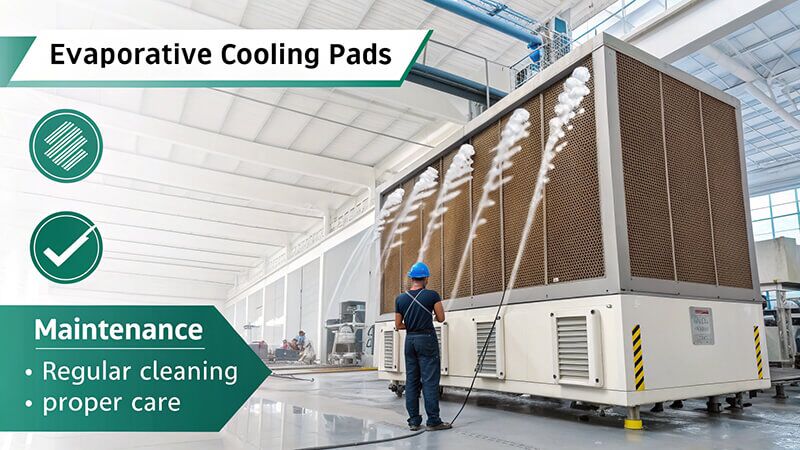
Replacing pads costs $300+ per section on industrial units. Try this deep-clean method first when pads feel crusty but aren’t torn:
- Remove front access panels and pull out pad frames.
- Soak pads in a 50/50 vinegar-water solution for 1 hour (use a plastic tub—never acid on concrete).
- Scrub gently with a soft brush—never pressure wash synthetic pads (aspen pads tolerate low PSI).
- Rinse thoroughly until water runs clear. Residual vinegar attracts dust.
- Reinstall and test—cooling efficiency should recover 70-80% if pads aren’t structurally damaged.
Pro Tip: Add 1 cup of commercial descaling solution (like Nu-Calgon Scale Gone) to the sump weekly during peak season to prevent future buildup.
Diagnosing Belt-Drive Blower Failures in Large Commercial Units

Squealing noises or reduced airflow often trace to belt issues in units over 15 tons. Don’t just tighten or replace belts—misalignment causes rapid wear. First, check pulley alignment using a straight edge across both pulleys. If misaligned by more than 1/8 inch, loosen motor mounting bolts and adjust. Second, inspect belts for glazing (shiny spots)—this means slippage from improper tension. Correct tension: You should depress the belt 1/2 inch per foot of distance between pulleys. Time Saver: Mark belt positions before removal to maintain optimal tracking.
When to Call a Professional for Commercial Swamp Cooler Repair
Some issues require licensed HVAC technicians to avoid safety risks or voided warranties:
- Burnt motor windings (smell of ozone, discolored insulation)
- Control board malfunctions causing short-cycling
- Refrigerant leaks in hybrid evaporative/refrigerant systems
- Structural frame rust compromising unit integrity
Critical: Never attempt motor rewinding on commercial units—improper winding causes dangerous vibration leading to catastrophic bearing failure. Budget $800-$2,500 for professional motor replacement depending on HP rating.
Annual Maintenance Checklist to Prevent Costly Commercial Swamp Cooler Repair
Avoid emergency calls with these twice-yearly tasks:
-
Pre-Season (Spring):
✓ Replace all cooling pads
✓ Clean sump basin with algaecide
✓ Lubricate motor bearings (if serviceable)
✓ Verify float valve operation -
Post-Season (Fall):
✓ Drain ALL water lines to prevent freeze damage
✓ Remove and store pump indoors
✓ Apply rust inhibitor to metal components
✓ Cover unit with waterproof tarp
Pro Tip: Install a water softener on the supply line for hard water areas—this cuts mineral buildup by 70% and extends pad life 2+ seasons.
Final Note: Mastering commercial swamp cooler repair hinges on systematic diagnostics—not guesswork. By prioritizing safety checks, targeting the top three failure points (pump, motor, float valve), and performing biannual maintenance, your team can resolve 85% of breakdowns in under 90 minutes. Keep spare pumps, capacitors, and float valves on-site to slash downtime during peak summer months. For complex electrical faults or motor replacements, always involve certified technicians—your facility’s cooling uptime depends on it. Implement these protocols, and you’ll transform swamp cooler maintenance from a crisis response into a predictable, cost-controlled operation.